The rooms and areas that make up the shared laboratory.
Facilities · CeprLab
The lab where it all happens — spaces, equipment, and the science we run on them.
CeprLab brings together three research lines under one roof at the University of Thessaly Lamia campus. Below: the spaces, the instruments, the safety framework, and how to find us.
- 138m² lab area
- 2Spaces
- 30+Instruments
- 2007Established
What is CeprLab
A shared laboratory for clinical exercise physiology and rehabilitation
The Clinical Exercise Physiology & Rehabilitation Laboratory (CeprLab) is a research lab within the Department of Physiotherapy at the University of Thessaly. It hosts three research lines — Pain Science, Cardiac Rehabilitation, and Pulmonary Rehabilitation — that share infrastructure, instrumentation, and a clinical-research safety framework.
Lab governance follows the Internal Regulations published under ΦΕΚ 3923/Β/2019. The Director (Prof. Eleni Kapreli) coordinates all research, equipment, and space use; the Senior ΕΤΕΠ member holds the Lab Secretariat, maintaining equipment registers, calibration logs, and booking sheets. Scheduled use prioritises the undergraduate (ΠΠΣ) and postgraduate (ΠΜΣ) teaching programmes; research slots in around them.
Research participants visit by appointment under approved protocols. Academic visitors and prospective collaborators are welcome to schedule a tour. Non-UTH researchers seeking access apply through the Secretariat with Department Assembly approval and Director sign-off.
At a glance
What's in the lab
- 2 regulated spaces · Room 125 + Gymnasium
- 30+ instruments · cardiopulmonary, musculoskeletal, neurophysiological
- 138 m² Room 125 floor area + shared gymnasium
- 2007 established · ΦΕΚ 2292/Β/2017 · 3923/Β/2019
Explore
Explore the laboratory
Jump to the spaces, the instruments, how we keep the lab safe, or how to visit.
Featured measurement and assessment equipment.
How the lab is kept safe for participants and staff.
Where we are and how to arrange a visit.
Spaces
Featured spaces
The full inventory of rooms, capacities, and floor plans lives in the Downloads archive.
ActiveInfrastructure
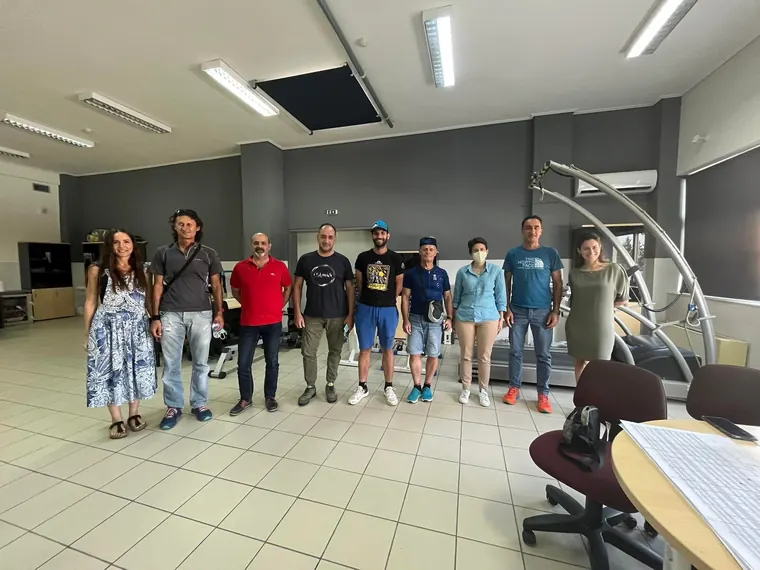
Room 125 · Main Lab
School of Health Sciences
The main CeprLab room — 138 m² of dedicated lab space hosting the cardiopulmonary, musculoskeletal, and neurophysiological instrumentation. All three research lines share the room under a Director-approved schedule.
School of Health Sciences · Room 125
ActiveInfrastructure
Gymnasium · School of Health Sciences
Shared exercise space
Shared exercise space for cardiopulmonary testing, intervention sessions, and movement-analysis protocols. Used by CeprLab under regulated access alongside Department teaching. Ground-floor locker rooms are available to study participants.
School of Health Sciences · Ground floorEquipment
Featured instruments
Full equipment inventory with manufacturer, model, and calibration status lives in the Downloads archive.
ActiveEquipment
Metamax Ergospirometry System
Cortex · cardiopulmonary exercise testing
Portable cardiopulmonary exercise testing (CPET) system measuring breath-by-breath oxygen uptake, ventilation, and gas exchange. Central instrument for the Cardiac and Pulmonary lines; also used for participant exercise-tolerance evaluation across studies.
Located in Room 125
ActiveEquipment
Biopac Exercise Physiology System
Multi-channel data acquisition · ECG · EMG · respiration
Multi-channel physiological data acquisition system supporting ECG, EMG, respiration, and other biosignals. Used across all three lines for synchronised multi-modal measurement during exercise testing, intervention sessions, and lab assessments.
Located in Room 125Safety framework
How we keep the lab safe
All clinical-research activity operates under the lab's Internal Regulations (ΦΕΚ 3923/Β/2019), with documented procedures, supervised access, and per-instrument booking. Four pillars structure the framework.
Ethics-first access
Every equipment use requires Ethics Committee approval (UTH or Department) and a documented research protocol, both checked before signature. No exceptions for student work.
Three-signature governance
Every booking passes through student → supervising faculty → ΕΤΕΠ lender → Director approval, documented per use and archived in the Lab Secretariat. External access also needs Department Assembly approval.
Per-instrument booking
Each instrument carries a booking sheet (φύλλο κράτησης) listing user, contact, time, supervising faculty, and use type. Sheets archive in the Secretariat; misuse triggers loss of access and retraining.
Off-site loan policy
Equipment loans for field use require Director approval. One-week default return; borrower covers damages; two-week maximum with weekly check-in. 24-hour wearables follow specific use-and-return protocols.
Funding acknowledgment
Who funds the work
CeprLab's research, equipment, and infrastructure are supported by EU programmes, Greek national funding, and clinical-research society grants. We acknowledge our funders here and in every publication.
European Union · Erasmus+ KA2
SportsComp · 2023–2026
Hellenic Cardiology Society
TELEWEAR-CR · research grant
Visit the lab
How to find us
CeprLab sits on the University of Thessaly Lamia campus, on the Old National Road between Lamia and Athens. Visits by appointment — academic visitors, collaborators, and research participants are all welcome.
Address
CeprLab · Department of PhysiotherapyUniversity of Thessaly · Lamia campus
3rd km Old National Road Lamia–Athens
35100 Lamia, Greece
Detailed directions by car, train, and bus to the UTH Lamia campus are available on request.
Schedule a visit
- Email — ceprlab@uth.gr
- Phone — +30 22310 60225
- Hours — Mon–Fri · 9:00–17:00
- All visits — by appointment
Schedule a visit
Want to see the lab in person?
Whether you're a prospective collaborator, an academic visitor, or considering joining a clinical-research study, we welcome scheduled visits. Send us a note and we'll find a time.
Contact the lab